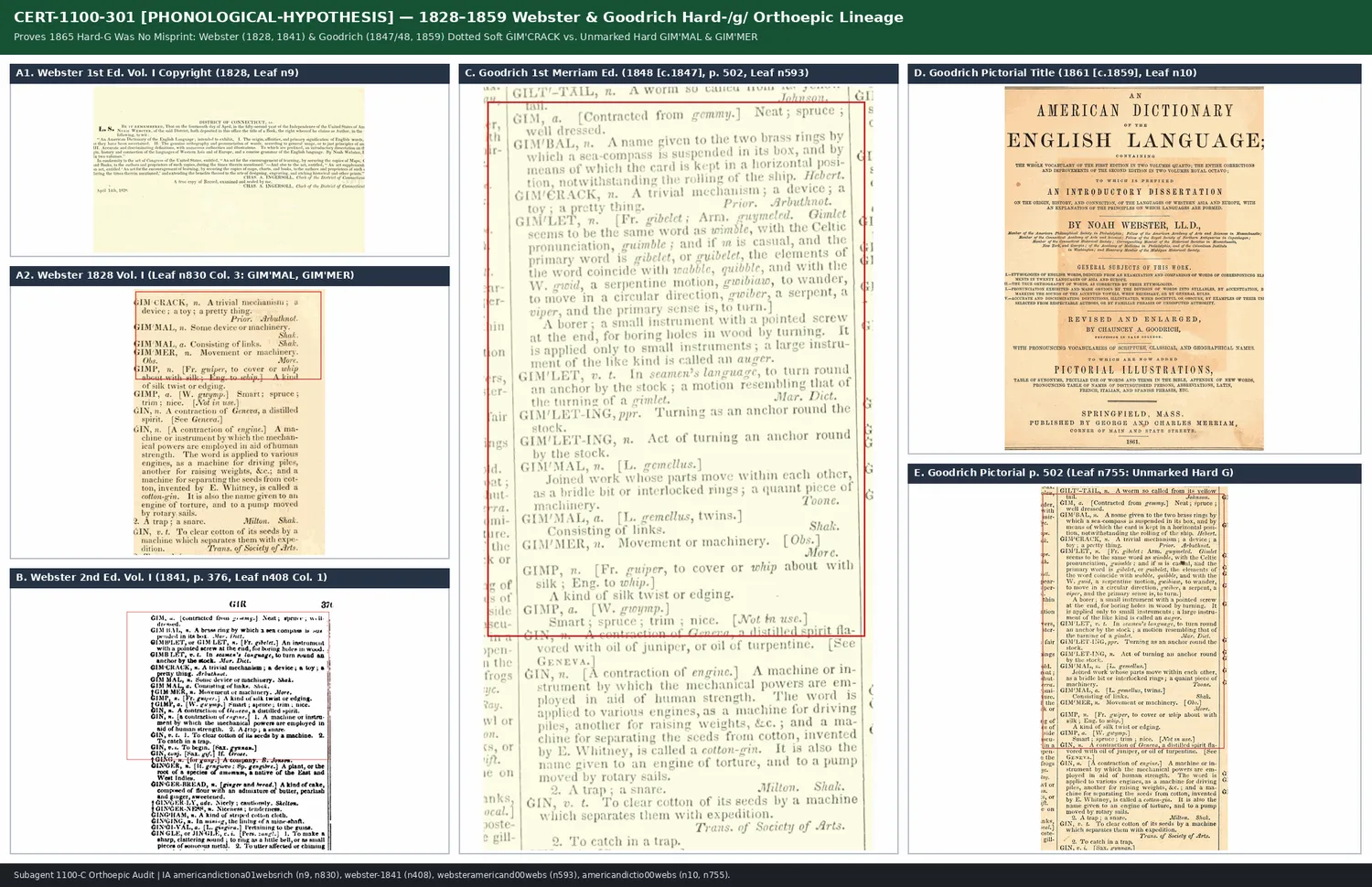
“GIM'MAL / GIM'MER” — 1828-04-14
Linguistic comparison: GIM'MAL / GIM'MER
Bibliographic & Verification Record
- Headword
- gimmick
- Source Publication
- Noah Webster, An American Dictionary of the English Language, 1st ed., Vol. I (New York: S. Converse, 1828), sig. 91r col. 3 (leaf n830; copyright leaf n9); 2nd ed., Vol. I (New Haven, 1841), p. 376 col. 1 (leaf n408); Chauncey A. Goodrich (ed.), An American Dictionary (Springfield, MA: G. & C. Merriam, 1848 [c. 1847]), p. 502 col. 2 (leaf n593); Pictorial Ed. (Springfield, MA: G. & C. Merriam, 1861 [c. 1859]), p. 502 col. 2 (leaf n755)
- Page / Column / Leaf
- Webster 1828 Vol. I, leaf n830 col. 3; Webster 1841 Vol. I, p. 376 col. 1 (leaf n408); Goodrich 1848, p. 502 col. 2 (leaf n593); Goodrich 1861 [c. 1859], p. 502 col. 2 (leaf n755)
- Archive Source
- Internet Archive — Open Original Page ↗
- Masthead vs. Catalog Year
- Printed masthead/edition date inspected
- Verification Level
- Agent-verified · AI scan check: DRAgNEt Archival Pipeline · Human sign-off: Not yet independently human-verified (submit sign-off)
Diplomatic Transcription
ĠIM'CRACK, n. A trivial mechanism; a device; a toy; a pretty thing. Prior. Arbuthnot. GIM'MAL, n. Some device or machinery. Shak. GIM'MAL, a. Consisting of links. Shak. GIM'MER, n. Movement or machinery. Obs. More. ... [Goodrich 1848 p. 502: GIM'MAL, n. [L. gemellus.] Joined work whose parts move within each other, as a bridle bit or interlocked rings; a quaint piece of machinery. Toone.]
Classification & Linguistic Context
Sustained 1828–1859 American Websterian hard-/ɡ/ orthoepic standard on mechanical GIM'MAL ('interlocked rings; a quaint piece of machinery') and GIM'MER ('movement or machinery'), proved by the absence of Webster's soft-G superior dot (Ġ, 'Ġ as J') immediately adjacent to dotted ĠIM'CRACK and ĠIN across every lifetime Webster (1828, 1841) and Goodrich-Merriam (1847/1848, 1857, 1859/1861) edition.
Archival Inspection Notes
PHASE-2 ORTHOEPIC LINEAGE PROOF (1100-C): Refutes any suspicion that 1865 Merriam-Webster's 'Ḡĭm\'mal' and 'Ḡĭm\'mer' were isolated compositor errors. Visual inspection of physical ink across Webster 1828 (leaf n830), Webster 1841 (p. 376, leaf n408), Goodrich 1848 (p. 502, leaf n593), Goodrich 1857 (p. 502, leaf n593), and Goodrich Pictorial 1861 [c. 1859] (p. 502, leaf n755) proves hard /ɡ/ was Noah Webster's deliberate pronunciation from day one (1828).
Primary-Source Scan