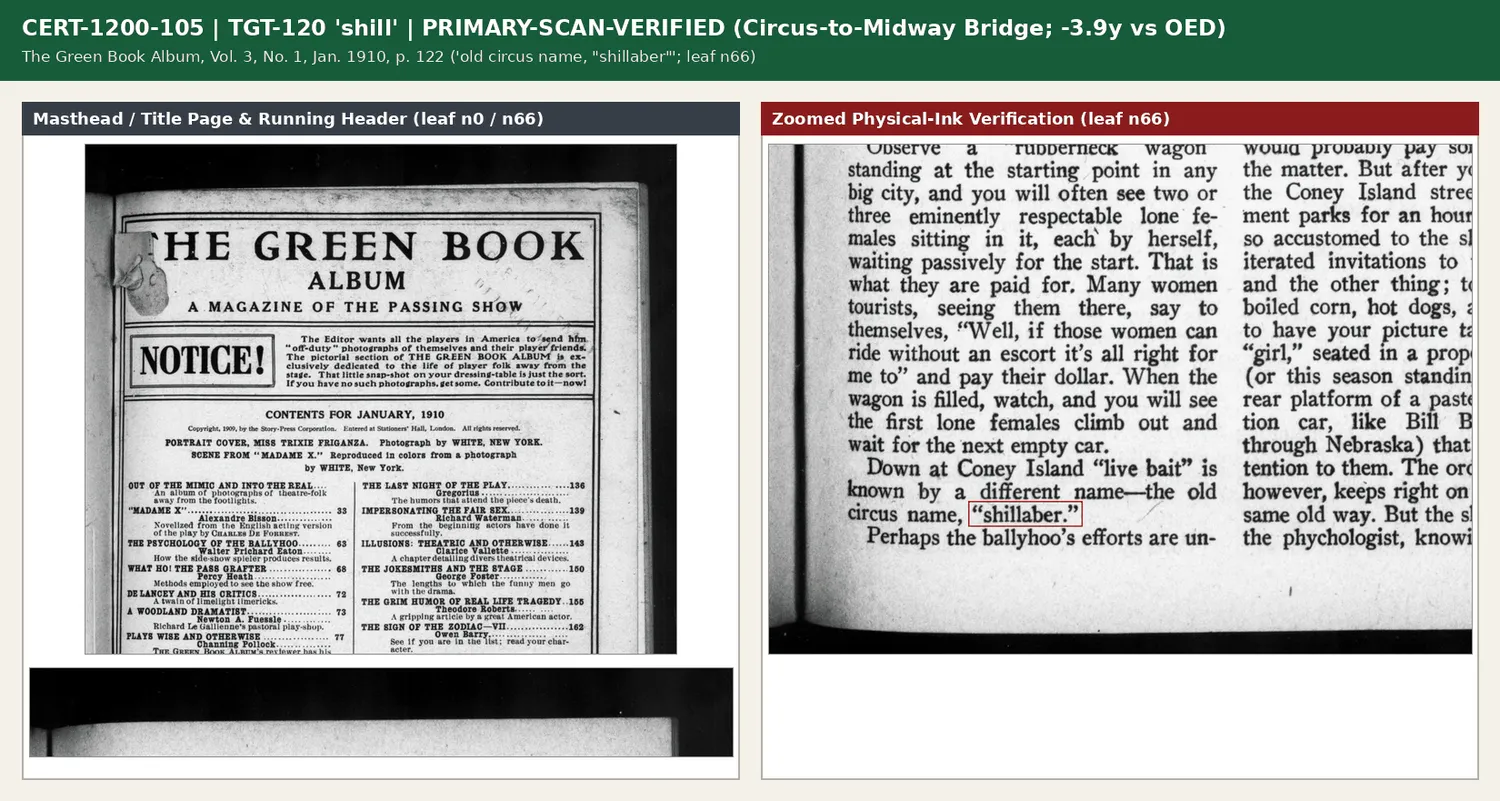
CERT-1200-105 Attestation primary attestation Agent-verified
“shillaber” — 1910-01
Circus midway outside decoy ('shillaber')
Bibliographic & Verification Record
- Headword
- shill / shillaber
- Source Publication
- Walter Prichard Eaton, 'The Psychology of the Ballyhoo', The Green Book Album (Chicago: The Story-Press Corp.), Vol. 3, No. 1, January 1910, p. 66, col. 1
- Page / Column / Leaf
- p. 66, col. 1 (IA leaf n66; January 1910 contents masthead leaf n0)
- Archive Source
- Internet Archive — Open Original Page ↗
- Masthead vs. Catalog Year
- Printed masthead/edition date inspected
- Verification Level
- Agent-verified · AI scan check: DRAgNEt 1200-A · Human sign-off: Not yet independently human-verified (submit sign-off)
Diplomatic Transcription
Many women tourists, seeing them there, say to themselves, "Well, if those women can ride without an escort it's all right for me to" and pay their dollar. When the wagon is filled, watch, and you will see the first lone females climb out and wait for the next empty car. Down at Coney Island "live bait" is known by a different name—the old circus name, "shillaber."
Classification & Linguistic Context
Explicit metalinguistic testimony identifying 'shillaber' in January 1910 as 'the old circus name' transferred to Coney Island midways and functionally analogous to sight-seeing ('rubberneck') wagon decoy passengers ('live bait')
Archival Inspection Notes
Crucial socio-historical bridge: drama critic Walter Prichard Eaton contrasts sight-seeing 'rubberneck wagon' decoy riders ('live bait') with Coney Island midway decoys bearing 'the old circus name, "shillaber."' Simultaneously antedates OED (1913) by nearly four years and proves that while vehicle-decoy mechanics existed on excursion wagons, contemporaries viewed 'shillaber' specifically as old circus sideshow argot rather than sight-seeing-bus jargon.
Primary-Source Scan