“Shillibeer” — 1834
Linguistic comparison: Shillibeer
Bibliographic & Verification Record
- Headword
- shill / shillaber
- Source Publication
- Henry Charles Moore, Omnibuses and Cabs: Their Origin and History (London: Chapman & Hall, 1902), pp. 29, 34 (quoting 1834 London broadside ballad, Bodleian Harding B 20(241))
- Archive Source
- Internet Archive — Open Original Page ↗
- Masthead vs. Catalog Year
- Printed masthead/edition date inspected
- Verification Level
- Agent-verified · AI scan check: DRAgNEt Archival Pipeline · Human sign-off: Not yet independently human-verified (submit sign-off)
Diplomatic Transcription
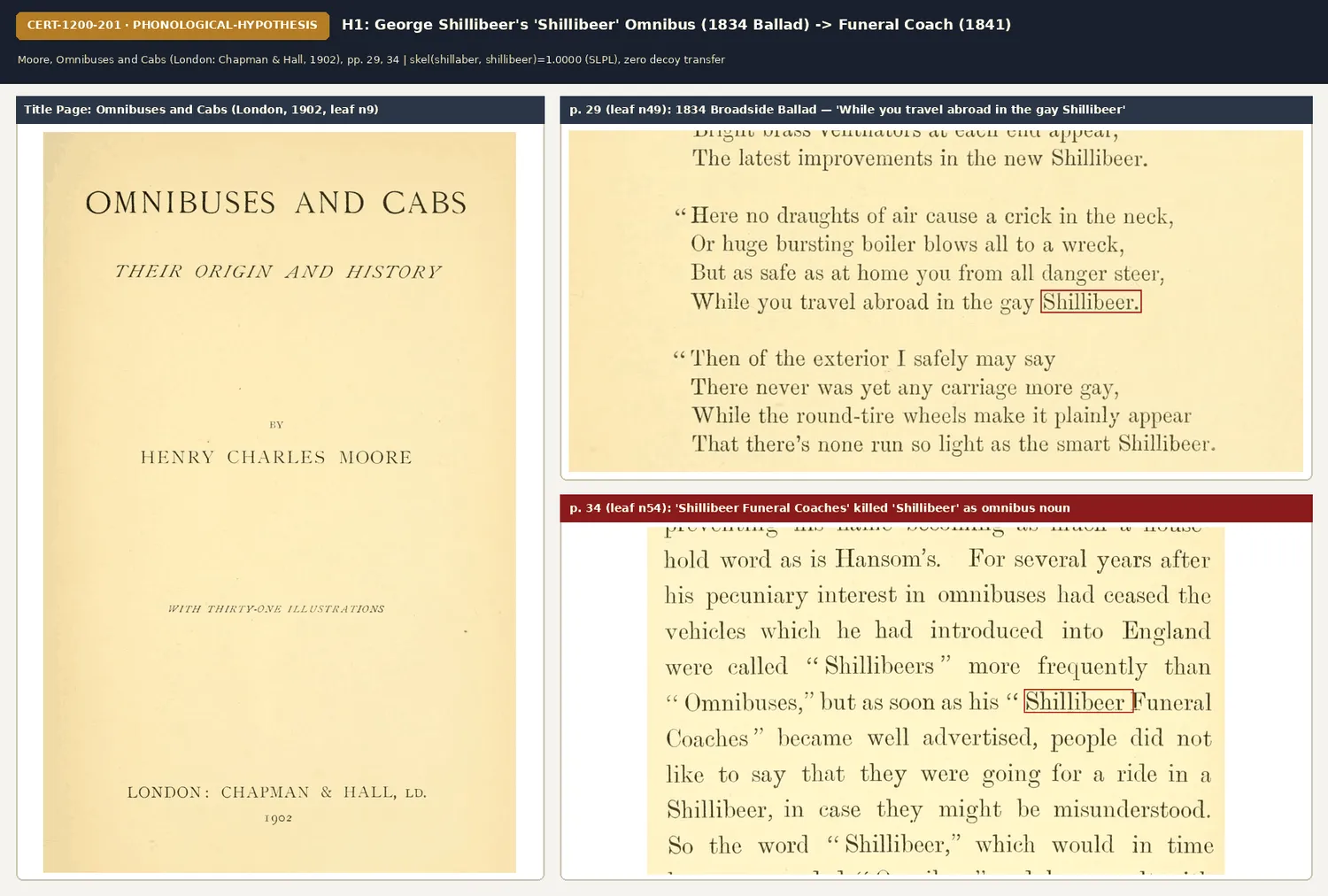
"Here no draughts of air cause a crick in the neck, Or huge bursting boiler blows all to a wreck, But as safe as at home you from all danger steer, While you travel abroad in the gay Shillibeer."
Archival Inspection Notes
Title-page date 1902 verified on leaf n9; 1834 Greenwich-omnibus broadside ballad verified on p. 29 (leaf n49), antedating OED1/OED2 'shillibeer, n.' (c. 1835 Ludgate 1897 reprint) by 1 year. Phonologically, 'Shillibeer' yields consonant skeleton SLPL, identical (edit distance 0, similarity 1.0000) to 'shillaber' (SLPL) and distance 2 (similarity 0.5000) to clipped 'shill' (SL). However, Moore p. 34 (leaf n54) proves why 'shillibeer' died out as a passenger-omnibus noun after Sept. 1841: once George Shillibeer advertised his patented combined hearse and mourning coach ('Shillibeer Funeral Coaches'), riders avoided saying they rode in a 'Shillibeer', restricting the noun in British usage to a pauper's hearse rather than a decoy passenger or tout.
Primary-Source Scan