CERT-1200-213 Contextual control precursor terminology Agent-verified
“ropers” — 1890
Precursor cant: 'bonnet', 'ropers', & 'steerers'
Bibliographic & Verification Record
- Headword
- shill / shillaber
- Source Publication
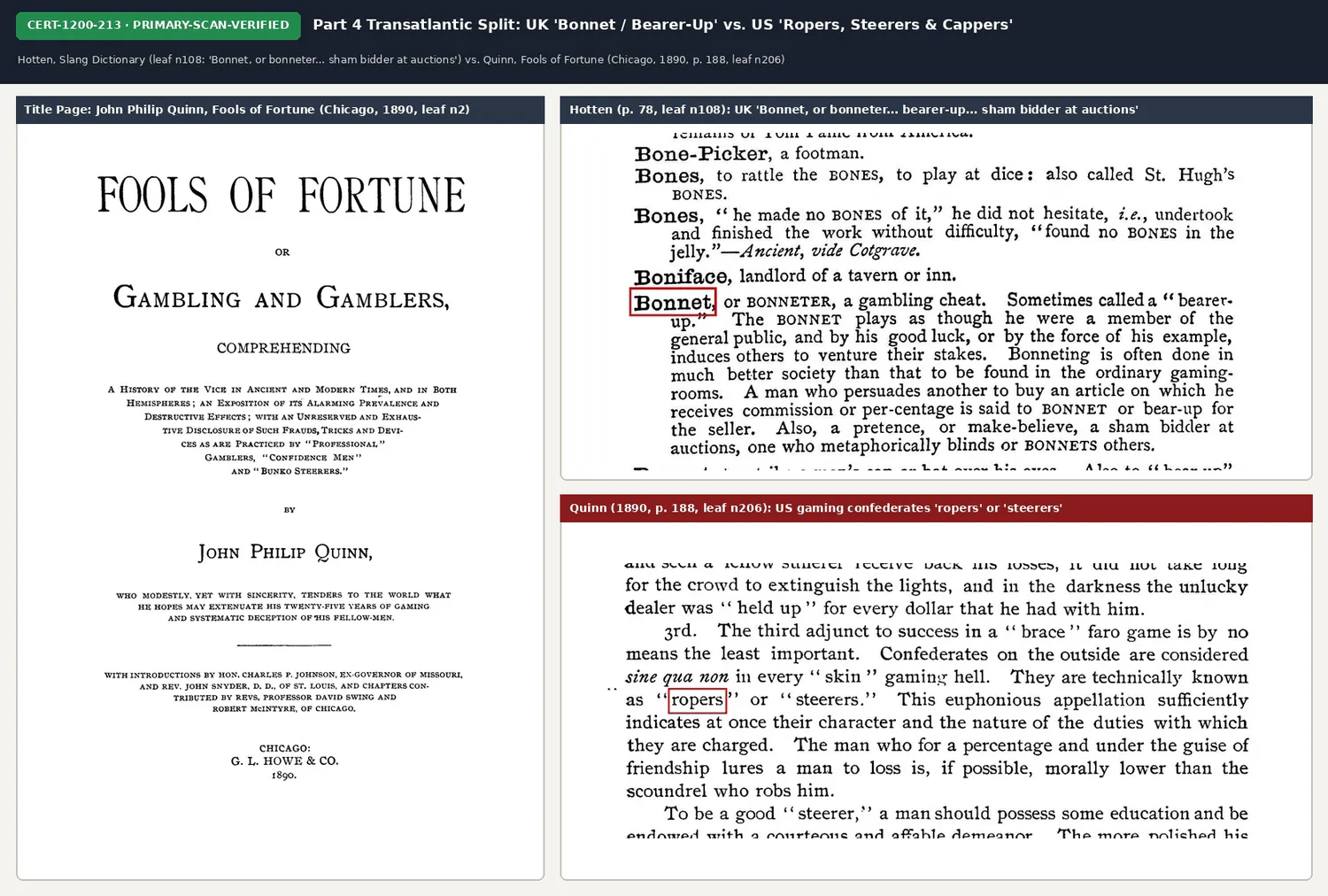
- John Philip Quinn, Fools of Fortune; or, Gambling and Gamblers (Chicago: G. L. Howe & Co., 1890), p. 188 (leaf n206; title leaf n2); paired with Hotten, Slang Dictionary (London, 1874 ed.), p. 78 (leaf n108)
- Archive Source
- Internet Archive — Open Original Page ↗
- Masthead vs. Catalog Year
- Printed masthead/edition date inspected
- Verification Level
- Agent-verified · AI scan check: DRAgNEt Archival Pipeline · Human sign-off: Not yet independently human-verified (submit sign-off)
Diplomatic Transcription
3rd. The third adjunct to success in a "brace" faro game is by no means the least important. Confederates on the outside are considered sine qua non in every "skin" gaming hell. They are technically known as "ropers" or "steerers." This euphonious appellation sufficiently indicates at once their character and the nature of the duties with which they are charged.
Archival Inspection Notes
Title page verified on leaf n2 ('CHICAGO: G. L. HOWE & CO. 1890.'). Maps the sharp late-19th-century transatlantic split in decoy terminology: while Britain used 'bonnet', 'bonneter', and 'bearer-up' across gaming rooms and mock auctions (Hotten p. 78, leaf n108), American three-card-monte, bunco, and brace-faro syndicates divided labor between outside 'ropers' / 'steerers' (who lured victims in) and inside 'cappers' (who feigned winning bets), with zero attestation of 'shillaber' in stationary indoor gaming hells prior to its emergence on traveling medicine-show, circus, and carnival lots.
Primary-Source Scan