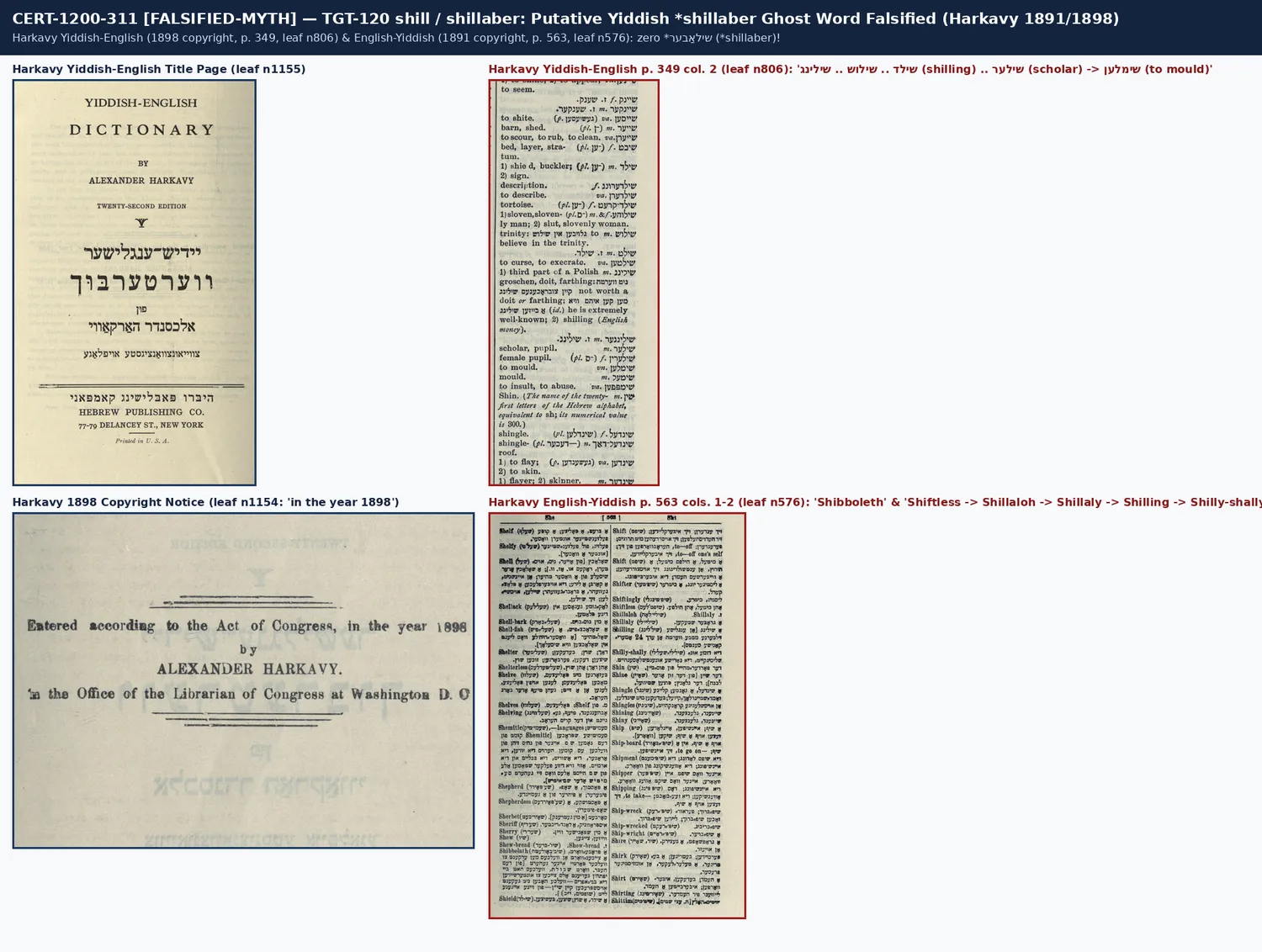
“Shilling” — 1898
Rejected lead (uncorroborated or folk etymology)
Bibliographic & Verification Record
- Headword
- shill / shillaber
- Source Publication
- Alexander Harkavy, Yiddish-English Dictionary / יידיש-ענגלישער ווערטערבוך (New York: copyright 1898 by Alexander Harkavy; bound with English-Yiddish Dictionary, copyright 1891, in IA englishyiddishan00harkuoft), Yiddish-English p. 349, col. 2 (leaf n806, 'שילד'–'שימלען') & English-Yiddish p. 563, cols. 1-2 (leaf n576, 'Shibboleth' & 'Shiftless'–'Shin'); cross-checked in Harkavy's 1925 Yiddish-English-Hebrew Dictionary (nybc201108)
- Page / Column / Leaf
- 1898 Copyright & Title leaves n1154-n1155; Yiddish-English p. 349 col. 2 (leaf n806); English-Yiddish p. 563 cols. 1-2 (leaf n576)
- Archive Source
- Internet Archive — Open Original Page ↗
- Masthead vs. Catalog Year
- Printed masthead/edition date inspected
- Verification Level
- Agent-verified · AI scan check: DRAgNEt Archival Pipeline · Human sign-off: Not yet independently human-verified (submit sign-off)
Diplomatic Transcription
שילטען va. to curse, to execrate. שילינג m. 1) third part of a Polish groschen, doit, farthing ... 2) shilling (English money). שילינגער m. ז. שילינג. שילער m. scholar, pupil. שילערין f. female pupil. שימלען vn. to mould. ... [English-Yiddish p. 563: Shibboleth (שיב'באָלעטה) אַ פּראָבע-װאָרט ... Shiftless ... Shillaloh ז. Shillaly. Shillaly אַ גראָבער שטעקען. Shilling אַ שילינג ... Shilly-shally ... Shin]
Classification & Linguistic Context
Viral internet/Wikipedia ghost etymology claiming English shill is 'an abbreviation of the Yiddish shillaber' (plus online StackExchange folk etymology from Yiddish/Hebrew shibboleth 'watchword') — FALSIFIED as a 100% nonexistent Yiddish ghost word.
Archival Inspection Notes
FALSIFIED-MYTH (1200-C Domain 3 Yiddish Ghost-Root Kill): An unsourced 2009 Wikipedia edit ('it may be an abbreviation of the Yiddish shillaber') was mirrored across dozens of reference sites, flagged as a 'house of mirrors' by Gabe Burns on Sesquiotica (25 Apr. 2011) and dismissed by Yiddish lexicographer David L. Gold (15 Apr. 2020: 'No Yidish lexeme or collocation of Yidish lexemes comes to mind that could be an immediate or a non-immediate etymon of English shill or English shillaber'). Our visual page-scan audit of Harkavy's 1898 Yiddish-English Dictionary (p. 349 col. 2, leaf n806) provides hard photographic proof: the entire Yiddish שיל- (shil-) sequence consists solely of שילד ('shield, sign'), שילדערונג ('description'), שילדערן ('describe'), שילד-קרעט ('tortoise'), שילופ ('sloven/slut'), שילוש ('trinity'), שילט / שילטען ('curse'), שילינג / שילינגער ('Polish groschen; English shilling'), and שילער / שילערין ('scholar, pupil' < MHG schüeler, SL vs SLPL = 0.5000, viable=False), stepping immediately to שימלען ('to mould') — ZERO *שילאַבער (*shillaber) in 1898 OR 1925 (nybc201108)! Likewise, English-Yiddish p. 563 (leaf n576) steps directly from Shiftless to Shillaloh, Shillaly, Shilling, Shilly-shally, and Shin, and defines Shibboleth (SPLS vs SLPL = 0.5000, viable=False) strictly as biblical Judges 12 test-word ('אַ פּראָבע-װאָרט'), killing the 2012 StackExchange shibboleth guess.
Primary-Source Scan