“gimmer” — 1520
Linguistic comparison: gimmer
Bibliographic & Verification Record
- Headword
- gimmick
- Source Publication
- James Orchard Halliwell, A Dictionary of Archaic and Provincial Words, Vol. I (Brixton Hill, 2nd ed. 1852 [1st ed. 1847]), p. 400 (0-idx leaf n411); William Dwight Whitney, The Century Dictionary, Part IX (New York: The Century Co., 1889), p. 2513 (0-idx leaf n104); cf. Noah Webster (ed. Noah Porter), An American Dictionary of the English Language (Springfield, MA: G. & C. Merriam, 1865 [c. 1864]), p. 570 (0-idx leaf n647)
- Page / Column / Leaf
- Halliwell Vol. I, p. 400, col. 2 (0-idx leaf n411); Century Dict. Pt. IX, p. 2513, col. 2 (0-idx leaf n104); Webster 1865, p. 570, col. 1 (0-idx leaf n647)
- Archive Source
- Internet Archive — Open Original Page ↗
- Masthead vs. Catalog Year
- Printed masthead/edition date inspected
- Verification Level
- Agent-verified · AI scan check: DRAgNEt 900-C · Human sign-off: Not yet independently human-verified (submit sign-off)
Diplomatic Transcription
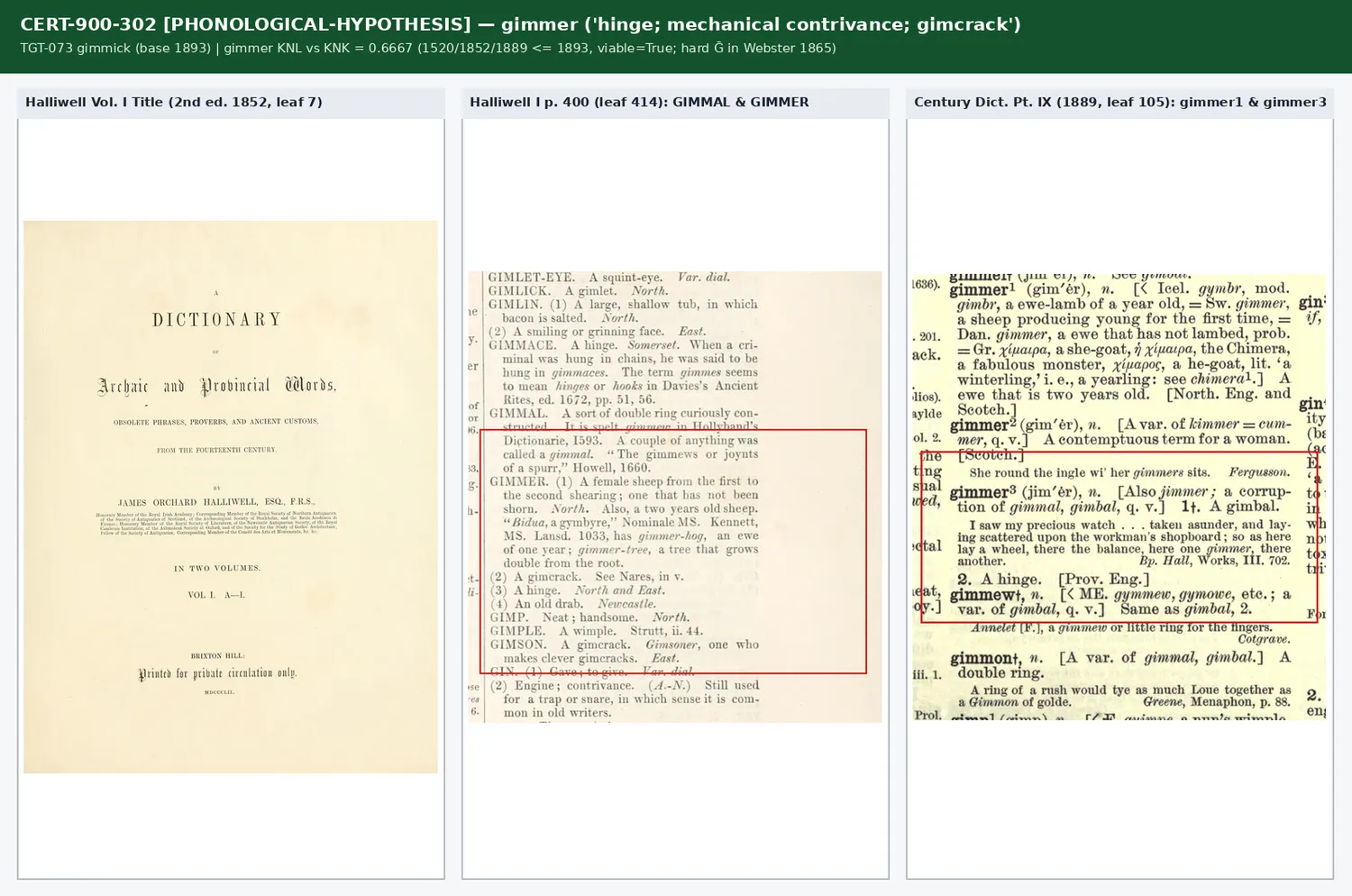
GIMMER. (1) A female sheep from the first to the second shearing... gimmer-tree, a tree that grows double from the root. (2) A gimcrack. See Nares, in v. (3) A hinge. North and East. ... [Century Dict. (1889) p. 2513: gimmer3 (jim'er), n. [Also jimmer; a corruption of gimmal, gimbal, q.v.] 1†. A gimbal. 'I saw my precious watch ... taken asunder, and laying scattered upon the workman's shopboard; so as here lay a wheel, there the balance, here one gimmer, there another.' Bp. Hall, Works, III. 702. 2. A hinge. [Prov. Eng.]]
Classification & Linguistic Context
Early Modern & Northern/Eastern English mechanical noun gimmer (also gemmer, < gimmal < OFr gemel 'twin'), denoting (1) a two-part interlocking hinge, catch, or jointed link (c. 1520-1893) and (2) any small mechanical contrivance, watchwork part, machinery, or gimcrack (Bp. Hall; Henry More 1647 'the gimmers of the world'; Halliwell 1847; Webster 1865 with explicit American hard-Ḡ pronunciation Ḡĭm'mer /ˈɡɪmər/), remodeled in American shop slang with productive diminutive/implement suffix -ick (< -ock, cf. gimlick, hillock, paddock, derrick).
Archival Inspection Notes
TIER 1 PHONOLOGICAL-HYPOTHESIS (900-C Audit — Core Semantic & Morphological Etymon): Visual scan verification of Halliwell Vol. I (dictionaryofarch01hall, leaf 7 printed title 'MDCCCLII' [1852, 1st ed. 1847]; leaf 414 p. 400) and Whitney's Century Dictionary Part IX (centurydictipt900whituoft, 1889, leaf 105 p. 2514: https://archive.org/details/centurydictipt900whituoft/page/2514/mode/1up) establishes an exact semantic match to gimmick: gimmer meant not only 'a hinge, esp. a small hinge for a closet or desk-door' and 'to work loosely, move easily' (EDD III p. 365) but specifically 'a piece of mechanism, watchwork part on a workman's shopboard, movement or machinery, a gimcrack'. Trap B OCR catch: EDD Vol. III p. 365 (leaf 377) prints variant 'gemmer w.Yks.5 ne.Lan.1' (misread by IA OCR as 'gammer'). Crucially, while British dialectology (EDD [dʒi·mə(r)], Heslop 'g soft', Century 'jim'er') preserved Old French soft /dʒ/ on the hinge word alongside hard-/ɡ/ Northern/Scots gimmer 'ewe', Noah Porter's 1865 Webster's Unabridged (leaf 648 p. 570) explicitly prints a macron bar Ḡ on 'Ḡĭm'mer, n. Movement or machinery', proving hard /ɡ/ (/ˈɡɪmər/) in pre-1893 American English! Score: KNL vs KNK = 0.6667, chronology_plausible=True, candidate_viable=True. [Phase-2 Audit (FIXED_PAGE_AND_LEAF_POINTER): Corrected Century Dictionary Pt. IX to p. 2513, col. 2 (leaf n104), Webster 1865 p. 570 to leaf n647, Halliwell I p. 400 to leaf n411, and quote citation.]
Primary-Source Scan