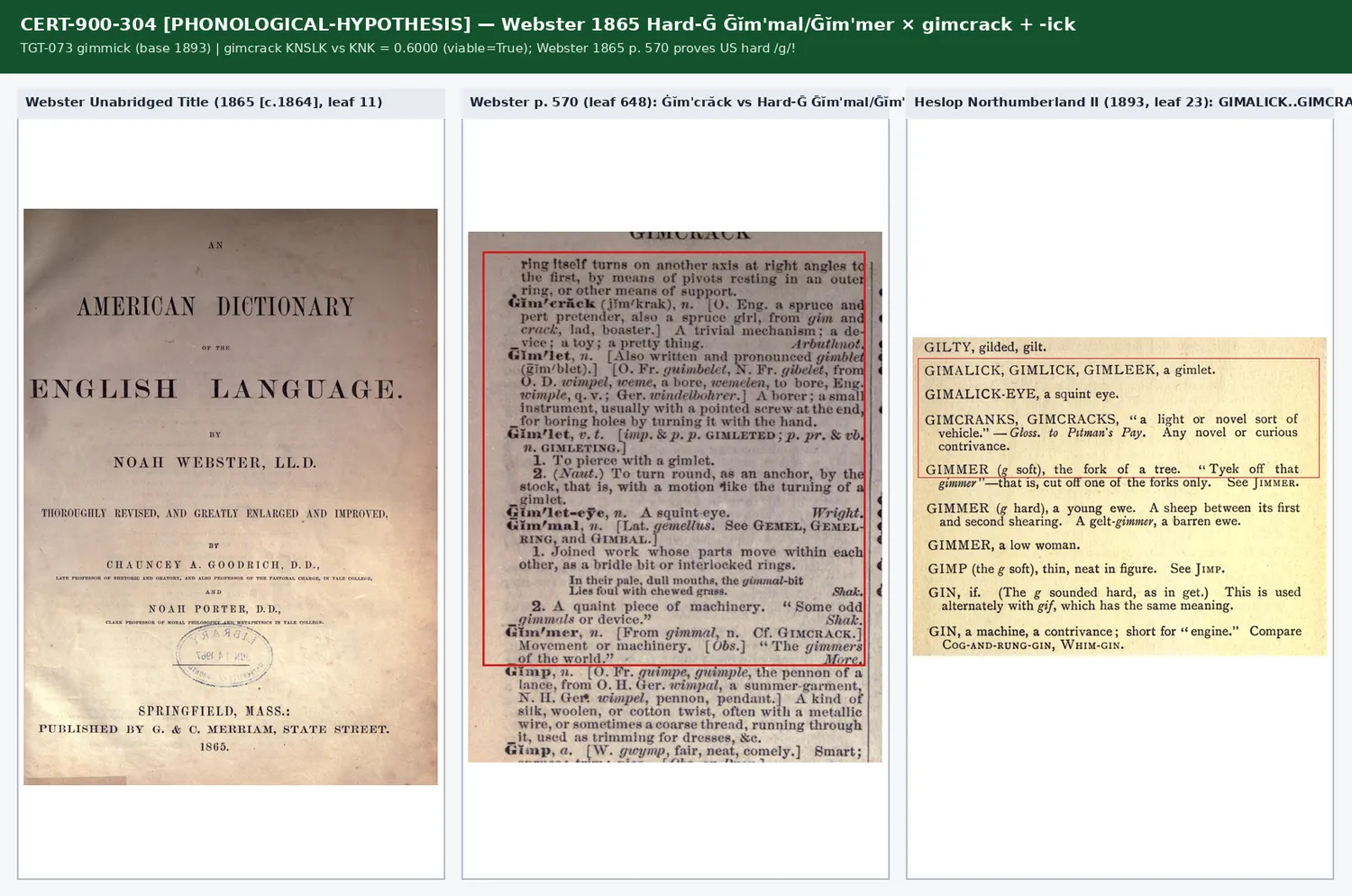
“Gim'crack” — 1865
Linguistic comparison: Gim'crack
Bibliographic & Verification Record
- Headword
- gimmick
- Source Publication
- Noah Webster (rev. Chauncey A. Goodrich & Noah Porter), An American Dictionary of the English Language (Springfield, MA: G. & C. Merriam, 1865 [copyright 1864]), p. 570 (0-idx leaf n647; title leaf n10); cf. R. O. Heslop, Northumberland Words, Vol. II (London: EDS, 1893), p. 325 (0-idx leaf n22)
- Page / Column / Leaf
- Webster 1865, p. 570, col. 1 (0-idx leaf n647); Heslop Vol. II (1893), p. 325 (0-idx leaf n22)
- Archive Source
- Internet Archive — Open Original Page ↗
- Masthead vs. Catalog Year
- Printed masthead/edition date inspected
- Verification Level
- Agent-verified · AI scan check: DRAgNEt 900-C · Human sign-off: Not yet independently human-verified (submit sign-off)
Diplomatic Transcription
Ġĭm'crăck (jĭm'krak), n. ... A trivial mechanism; a device; a toy; a pretty thing. Arbuthnot. Ḡĭm'let, n. [Also written and pronounced gimblet (ḡĭm'blet).] ... A borer... Ḡĭm'mal, n. [Lat. gemellus. See GEMEL, GEMEL-RING, and GIMBAL.] 1. Joined work whose parts move within each other, as a bridle bit or interlocked rings. ... 2. A quaint piece of machinery. 'Some odd gimmals or device.' Shak. Ḡĭm'mer, n. [From gimmal, n. Cf. GIMCRACK.] Movement or machinery. [Obs.] 'The gimmers of the world.' More.
Classification & Linguistic Context
Secondary semantic/morphological blend of gimcrack ('a trivial mechanism; a device; any novel or curious contrivance', 1638/1865) with the explicitly hard-/ɡ/ American lexical pair Ḡĭm'mal ('quaint piece of machinery') and Ḡĭm'mer ('movement or machinery', explicitly marked with macron Ḡ = hard /ɡ/ as in get in Webster 1864/1865 p. 570!) plus diminutive/implement suffix -ick (< -ock, or cadence of knick-knack / thingumbob).
Archival Inspection Notes
TIER 2 PHONOLOGICAL-HYPOTHESIS & DECISIVE HARD-/ɡ/ ORTHOEPIC BREAKTHROUGH (900-C Audit): OED3 (s.v. gimmick, n., rev. June 2026) doubts direct derivation from British gimcrack alone because gimcrack has soft /dʒ/ (/ˈdʒɪmkræk/). Physical ink inspection of G. & C. Merriam's 1865 Webster Unabridged (americandictiona00websuoft, leaf 11 printed title '1865'; leaf 648 p. 570, running footer key 'ġ as j; ḡ as in get') resolves that exact phonological barrier: while Ġĭm'crăck carries a superior dot (soft /dʒ/), BOTH Ḡĭm'mal ('Joined work whose parts move within each other... 2. A quaint piece of machinery') AND Ḡĭm'mer ('[From gimmal, n. Cf. GIMCRACK.] Movement or machinery') carry an unmistakable superior MACRON BAR (Ḡ = hard /ɡ/)! Thus in pre-1893 American English, gimmal/gimmer already possessed hard /ɡɪm-/ and explicit cross-reference to gimcrack ('a trivial mechanism; a device'). Score for gimcrack: KNSLK vs KNK, edit_distance=2, skeleton_similarity=0.6000, chronology_plausible=True, candidate_viable=True (secondary blend donor alongside Tier 1 hard-/ɡ/ gimmer/gimlick). [Phase-2 Audit (FIXED_PAGE_AND_LEAF_POINTER): Updated Webster 1865 to 0-idx leaf n647 (/page/n647/mode/1up) and Heslop Vol. II to printed p. 325 (0-idx leaf n22).]
Primary-Source Scan